


पेशाब रुकना / पेशाब कम आना (Urinary Retention)
Table of Contents
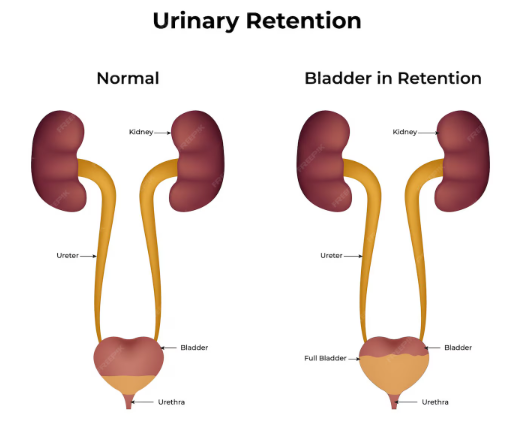
Urinary Retention / Reduced Urine Flow
What is it?
Urinary Retention is a condition in which the bladder becomes full of urine but the patient is unable to empty it completely. It may occur suddenly (acute urinary retention) or may develop slowly over time as chronic urinary retention.
Types
1. Acute Urinary Retention
- Sudden inability to pass urine
- Severe pain in the lower abdomen
- This is considered a medical emergency
2. Chronic Urinary Retention
- Urine passes slowly or in small amounts
- The bladder does not empty completely
- Sometimes patients may not notice the problem initially
Possible Causes
- Enlarged prostate (BPH)
- Blockage in the urethra (urethral stricture)
- Kidney or bladder stones
- Side effects of certain medications
- Nervous system disorders
- Temporary blockage after surgery
Main Symptoms
- Inability to urinate
- Difficulty starting urination
- Weak urine stream
- Swelling or heaviness in the lower abdomen
- Feeling that the bladder is not completely empty
Diagnosis
The following tests may be recommended to determine the cause:
- Ultrasound bladder
- Post-void residual urine measurement
- Urine test
- Kidney function blood test
In some cases, Cystoscopy and Urodynamic study may also be required.
Emergency Treatment
In cases of acute urinary retention, the first step is to empty the bladder immediately.
- Catheterization
A catheter is inserted through the urinary passage to drain the bladder and provide immediate relief. - Sometimes a Suprapubic catheter (a catheter inserted through the lower abdomen) may be required.
Further Treatment
Treatment depends on the underlying cause.
1. Medical Treatment
- Medications for prostate enlargement
- Treatment for infection if present
2. Endoscopic Procedures
- TURP (Transurethral Resection of the Prostate)
Endoscopic surgery to remove enlarged prostate tissue - Urethrotomy
Endoscopic surgery to open a narrowed urethra in urethral stricture
Possible Complications
If urinary retention continues for a long time, it may lead to:
- Repeated infections
- Bladder damage
- Kidney damage
When to See a Doctor Immediately
- Complete inability to urinate
- Severe abdominal pain
- Urinary retention with fever
- Blood in urine
This condition can be a medical emergency.
Prevention
- Timely treatment of prostate problems
- Avoid holding urine for long periods
- Take medications as advised by your doctor
What to Do Next?
- Book an appointment
- Consult a doctor for proper evaluation and treatment
For More Information
- European Association of Urology – Male LUTS Guidelines
- American Urological Association – BPH / Urinary Retention Guidelines
- Urological Society of India – LUTS Practice Recommendations